

TAKE F5-CA F5CAB5 PRACTICE QUESTIONS FOR AMAZING RESULTS
F5 F5CAB5 Exam Dumps Are Essential To Get Good Marks
NEW QUESTION # 42
A BIG-IP Administrator creates a new Virtual Server. The end user is unable to access the page.
During troubleshooting, the administrator learns that the connection between the BIG-IP system and server is NOT set up correctly. What should the administrator do to solve this issue?
- A. Disable Address Translation
- B. Set Address Translation to Auto Map, configure a SNAT pool, and have pool members in the same subnet of the servers
- C. Set Address Translation to SNAT and have self-IP configured in the same subnet of servers
- D. Set Address Translation to SNAT and configure a specific translation address
Answer: D
Explanation:
When a virtual server is not working as expected despite the pool members being marked "UP" (Green), the issue is frequently a return-path routing failure. If the BIG-IP forwards a request with the original client's source IP address, the backend server will try to respond directly to that client.
If the server does not have its default gateway pointed back to the BIG-IP, the response packet will be routed elsewhere (or dropped), resulting in a connection timeout for the user. To resolve this, the administrator must configure "Source Address Translation" (SNAT). By setting SNAT to
"Automap" or a specific SNAT address, the BIG-IP replaces the client's IP with its own internal self-IP. The backend server then sees the BIG-IP as the source and sends the response back to it locally. This troubleshooting step ensures a functional, symmetric traffic flow. Identifying the need for SNAT is one of the most common troubleshooting tasks for new virtual server deployments where the BIG-IP is not the default gateway for the backend servers.
NEW QUESTION # 43
Where should the BIG-IP Administrator go in the GUI to verify the status of pool members of a pool?
- A. Local Traffic -> Virtual Servers -> Statistics
- B. Local Traffic -> Pools
- C. Local Traffic -> Pools -> <pool_in_question> -> Members
- D. Local Traffic -> Nodes
Answer: C
Explanation:
To verify the specific health and availability status of individual members within a specific pool, the administrator must navigate to the Members tab of that specific pool.
* Navigation Path: The correct path is Local Traffic > Pools > Pool List, then clicking on the name of the <pool_in_question>, and finally selecting the Members tab. This screen provides a granular view of each member's IP address, port, and their current status (indicated by the colored icons: Green, Red, Yellow, or Blue).
* Why Option A is correct: While you can see a general status summary on the Pool List page (Option B), that page only shows the status of the pool as a whole. To troubleshoot why a pool is not working or to see which specific member is down, you must drill down into the Members tab.
* Evaluation of Other Options:
* Local Traffic -> Pools (Option B): This leads to the Pool List. It shows the aggregate status of all pools but does not list individual member details or their specific monitor results without further clicking.
* Local Traffic -> Virtual Servers -> Statistics (Option C): This path shows traffic statistics (bits in/out, connections) for virtual servers, not the health monitor status of individual pool members.
* Local Traffic -> Nodes (Option D): While this shows the health of the underlying IP address (Node), it does not show the status of the specific service (Port/Member) within a pool. A Node might be "Up" (ICMP), while the Pool Member is "Down" (HTTP failure).
NEW QUESTION # 44
Which Virtual Server type prevents the use of a default pool?
- A. Forwarding (IP)
- B. Standard
- C. Performance (Layer 4)
- D. Performance HTTP
Answer: A
Explanation:
In BIG-IP TMOS administration, the "Forwarding (IP)" virtual server type is unique because it is designed to act as a high-performance router rather than a typical load balancer. Unlike a
"Standard" virtual server, which terminates a connection and directs it to a specific pool of members, a Forwarding (IP) virtual server is intended to forward packets based on the system's routing table. Consequently, the configuration for this type of virtual server explicitly removes the option to associate a default pool. If an administrator is troubleshooting a scenario where they cannot assign a pool to a virtual server, they must verify if the type was accidentally set to Forwarding (IP). This type is most commonly used for outbound internet traffic (outbound SNAT) or to allow the BIG-IP to serve as a gateway between internal subnets. Identifying this constraint is vital for troubleshooting configuration errors where an administrator expects the system to load balance traffic but finds the pool association settings are grayed out or unavailable in the Configuration Utility.
NEW QUESTION # 45
Refer to the exhibit.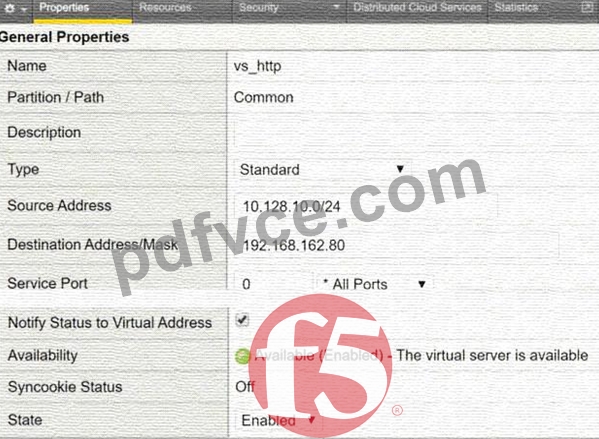
A user with IP address 192.168.162.70 is unable to connect to an HTTP application. What is a possible cause within the Virtual Server configuration?
- A. The Virtual Server is configured as a Standard Type
- B. The Destination Address is configured as 192.168.162.80
- C. The Source Address is configured as 10.128.10.0/24
- D. The Service Port is configured as 0 *All Ports
Answer: C
Explanation:
The failure to connect is caused by a restrictive Source Address filter configured on the Virtual Server.
* Source Address Filtering: In the BIG-IP system, the Source Address field on a Virtual Server acts as an implicit Access Control List (ACL). Only traffic originating from a client IP address that matches the specified network range will be accepted and processed by the Virtual Server.
* Analyzing the Exhibit: The provided configuration for vs_http shows the Source Address is set to
10.128.10.0/24. This means the Virtual Server will only accept connections from the subnet ranging from 10.128.10.1 to 10.128.10.254.
* Identifying the Conflict: The user trying to connect has the IP address 192.168.162.70. Since
192.168.162.70 does not fall within the allowed 10.128.10.0/24 range, the BIG-IP system will not match this traffic to the Virtual Server, effectively blocking the connection attempt.
* Evaluation of Other Options:
* All Ports (Option A): Configuring a Virtual Server for "All Ports" (port 0) allows it to handle traffic for any destination port, which would not block a standard HTTP application.
* Destination Address (Option B): The destination address 192.168.162.80 is the Virtual IP (VIP) users should be connecting to; this is a standard configuration and not the cause of the failure for a user reaching out to it.
* Standard Type (Option C): A "Standard" Virtual Server is the most common type used for HTTP applications as it allows for Layer 7 profiles and full proxy capabilities.
NEW QUESTION # 46
A device group is currently in theChanges Pendingsync status. How can the BIG-IP Administrator determine which member of the device group has the most recent configuration? (Choose one answer)
- A. Device Management > Devices
- B. Device Management > Device Groups
- C. Device Management > Over
- D. System > High Availability
Answer: C
NEW QUESTION # 47
A BIG-IP Administrator uses backend servers to host multiple services per server. There are multiple virtual servers and pools defined, referencing the same backend servers. Which load balancing algorithm is most appropriate to have an equal number of connections on each backend server?17
- A. Predictive (node)
- B. Least Connections (member)
- C. Least Connections (node)
- D. Predictive (member)
Answer: C
Explanation:
Comprehensive and Detailed Explanation From BIG-IP Administration Support and Troubleshooting documents: When load balancing is not working as 23expected and connections appear skewed across physical hardware, the administrator must distinguish between "member"24 and "node" level balancing. A "member" refers to a specific IP and Port combination (e.g., 10.1.1.1:80), whereas a "node" refers to the underlying IP address (10.1.1.1) regardless of the port25. If a single server hosts multiple services (Web, FTP, API) across different pools, using "Least Connections (member)" would only balance connections within each individual pool26. This could lead to a scenario where one server is overwhelmed because it is winning the "least connections" count in three different pools simultaneously. By selecting "Least Connections (node)," the BIG-IP tracks the total number of concurrent connections to the physical IP address across all pools it belongs to27. This ensures that the administrator can maintain an equal distribution of work across the hardware, preventing performance degradation on backend servers that host multiple application services.
NEW QUESTION # 48
A BIG-IP Administrator uses backend servers to host multiple services per server. There are multiple virtual servers and pools defined, referencing the same backend servers. Which load balancing algorithm is most appropriate to have an equal number of connections on each backend server?17
- A. Predictive (node)
- B. Least Connections (member)
- C. Least Connections (node)
- D. Predictive (member)
Answer: C
Explanation:
When load balancing is not working as 23expected and connections appear skewed across physical hardware, the administrator must distinguish between "member"24 and "node" level balancing. A "member" refers to a specific IP and Port combination (e.g., 10.1.1.1:80), whereas a "node" refers to the underlying IP address (10.1.1.1) regardless of the port25. If a single server hosts multiple services (Web, FTP, API) across different pools, using "Least Connections (member)" would only balance connections within each individual pool26.
This could lead to a scenario where one server is overwhelmed because it is winning the "least connections" count in three different pools simultaneously. By selecting "Least Connections (node)," the BIG-IP tracks the total number of concurrent connections to the physical IP address across all pools it belongs to27. This ensures that the administrator can maintain an equal distribution of work across the hardware, preventing performance degradation on backend servers that host multiple application services.
NEW QUESTION # 49
Refer to the exhibit. A BIG-IP Administrator creates a new Virtual Server to load balance SSH traffic. Users are unable to log on to the servers. What should the BIG-IP Administrator do to resolve the issue? (Exhibit shows a Standard Virtual Server with an HTTP profile applied).
- A. Set Destination Addresses/Mask to 0.0.0.0/011
- B. Set Protocol to UDP8
- C. Set HTTP Profile to None9
- D. Set Source Address to 10.1.1.210
Answer: C
Explanation:
When troubleshooting a Virtual Server that is not working as expected, it is critical to ensure that the applied profiles match the type of traffic being processed. SSH (Secure Shell) is a non-HTTP protocol that operates over TCP. The exhibit indicates that an HTTP profile is applied to the Virtual Server. An HTTP profile instructs the BIG-IP system to parse traffic as HTTP; however, since SSH traffic does not follow HTTP specifications, the BIG-IP's parser will fail to understand the data stream, typically resulting in dropped packets or reset connections. To fix this, the administrator must set the HTTP profile to "None". This allows the Virtual Server to act as a
"Standard" or "FastL4" listener that passes the encrypted SSH data transparently to the backend pool members without attempting application-layer inspection. This highlights a common troubleshooting step: verifying that L7 profiles are not inadvertently applied to L4 traffic, which disrupts the expected traffic flow between the client and the server.
NEW QUESTION # 50
Some users who connect to a busy Virtual Server have connections reset by the BIG-IP system.
Pool member resources are NOT a factor in this behavior. What is a possible cause for this behavior?
- A. The Connection Rate Limit is set too high
- B. The Connection Limit is set too low.
- C. The server SSL Profile has NOT been reconfigured.
- D. The Rewrite Profile has NOT been configured.
Answer: B
Explanation:
When troubleshooting intermittent connection resets on a "busy" Virtual Server, the administrator must examine the configured thresholds. A "Connection Limit" is a hard cap on the number of concurrent connections a Virtual Server or pool member can handle. If this limit is set too low, the BIG-IP will reset any new connection attempts once the threshold is reached. The key indicator in this scenario is that the problem only affects "some users" and happens when the server is
"busy," suggesting that the system is hitting a capacity ceiling rather than suffering from a persistent configuration error. Unlike a missing SSL profile, which would likely cause all connections to fail, or a "Connection Rate Limit," which throttles how fast connections arrive, a
"Connection Limit" focuses on the total volume. Identifying this as the cause requires reviewing the Virtual Server's statistics to see if the "Current Connections" count is consistently peaking at the configured limit value.
NEW QUESTION # 51
Refer to the exhibit.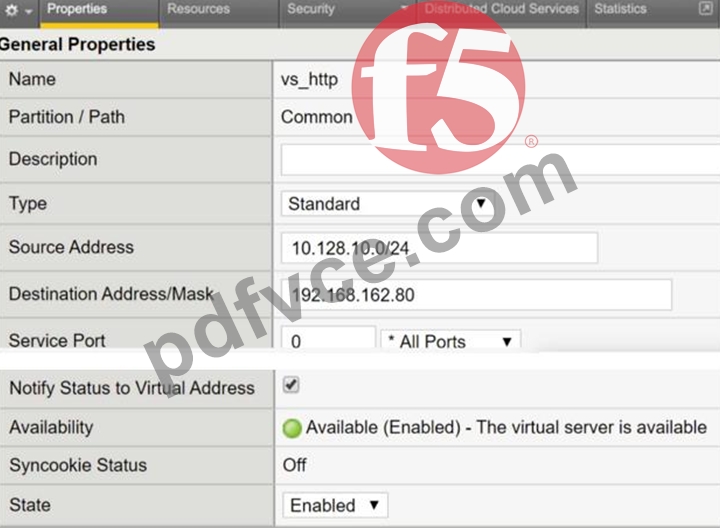
A user with IP address 192.168.162.70 is unable to connect to an HTTP application. What is a possible cause within the Virtual Server configuration?
- A. The Virtual Server is configured as a Standard Type
- B. The Destination Address is configured as 192.168.162.80
- C. The Source Address is configured as 10.128.10.0/24
- D. The Service Port is configured as 0 *All Ports
Answer: C
Explanation:
The failure to connect is caused by a restrictive Source Address filter configured on the Virtual Server.
Source Address Filtering: In the BIG-IP system, the Source Address field on a Virtual Server acts as an implicit Access Control List (ACL). Only traffic originating from a client IP address that matches the specified network range will be accepted and processed by the Virtual Server.
Analyzing the Exhibit: The provided configuration for vs_http shows the Source Address is set to 10.128.10.0/24. This means the Virtual Server will only accept connections from the subnet ranging from 10.128.10.1 to 10.128.10.254.
Identifying the Conflict: The user trying to connect has the IP address 192.168.162.70. Since 192.168.162.70 does not fall within the allowed 10.128.10.0/24 range, the BIG-IP system will not match this traffic to the Virtual Server, effectively blocking the connection attempt.
Evaluation of Other Options:
All Ports (Option A): Configuring a Virtual Server for "All Ports" (port 0) allows it to handle traffic for any destination port, which would not block a standard HTTP application.
Destination Address (Option B): The destination address 192.168.162.80 is the Virtual IP (VIP) users should be connecting to; this is a standard configuration and not the cause of the failure for a user reaching out to it.
Standard Type (Option C): A "Standard" Virtual Server is the most common type used for HTTP applications as it allows for Layer 7 profiles and full proxy capabilities.
NEW QUESTION # 52
Which command checks disk usage?
- A. ps aux
- B. df -h
- C. ls -l
- D. free -m
Answer: B
NEW QUESTION # 53
A BIG-IP Administrator needs to determine why only one pool member is showing connections from the virtual server, resulting in uneven load balancing.
What two reasons would cause uneven load balancing? (Choose two answers)
- A. The virtual server is marked down.
- B. All pool members are marked down.
- C. The pool has a persistence profile configured.
- D. Monitors have marked down multiple pool members.
Answer: C,D
Explanation:
Uneven load balancing on a BIG-IP system typically occurs when traffic is not distributed evenly across all available pool members. One common reason is that monitors have marked down multiple pool members (Option B). When health monitors fail for specific pool members, BIG-IP automatically removes those members from load-balancing decisions. As a result, traffic is sent only to the remaining healthy member, creating the appearance that load balancing is not functioning correctly. This behavior is expected and aligns with BIG-IP's design to ensure traffic is sent only to healthy resources.
Another frequent cause is the presence of a persistence profile on the pool or virtual server (Option C). Persistence (such as source address or cookie persistence) forces subsequent client connections to be sent to the same pool member for session continuity. While persistence is critical for certain applications, it can override the load-balancing algorithm and cause most or all traffic to be directed to a single pool member, especially during low traffic volumes or testing scenarios.
The other options are incorrect because a virtual server marked down (Option A) would not pass traffic at all, and all pool members marked down (Option D) would result in no connections rather than uneven distribution. This analysis follows standard BIG-IP troubleshooting methodology using pool status, monitor results, and persistence configuration review.
NEW QUESTION # 54
The BIG-IP is experiencing issues with data plane resources. Which traffic processing would be most impacted?
- A. APM sessions
- B. MCPD transactions
- C. iControl transactions
- D. Configuration utility
Answer: A
Explanation:
The BIG-IP architecture is divided into two distinct planes: the Control Plane (Management) and the Data Plane (Traffic Management Microkernel - TMM).
* Data Plane (TMM): This plane is responsible for the actual processing of application traffic, including load balancing, SSL offloading, and session management for modules like APM (Access Policy Manager). If data plane resources (CPU/Memory allocated to TMM) are exhausted, active user sessions and traffic throughput are directly degraded.
* APM Sessions: Because APM sessions are managed within the TMM process to ensure high-speed access control and tunneling, they are a primary "Data Plane" function.
* Control Plane Functions: Options A, B, and D (MCPD, Configuration Utility/GUI, and iControl) all reside in the Control Plane (running on the Linux host OS). While a total system hang affects both, a specific "data plane resource issue" is designed to isolate and impact the traffic-handling services like APM while the management GUI might remain responsive.
NEW QUESTION # 55
A BIG-IP device sends out the following SNMP trap: big-ipo.f5.com - bigipExternalLinkChange Link: 1.0 is DOWN. Where in the BIG-IP Configuration utility should the BIG-IP Administrator verify the current status of Link 1.0?
- A. System > Platform
- B. Network > Interfaces > Interface List
- C. Network > Trunks > Trunk List
- D. Statistics > Performance > System
Answer: B
Explanation:
Comprehensive and Detailed Explanation From BIG-IP Administration Support and Troubleshooting documents: Identifying network-level performance issues often starts with investigating hardware-level alerts78. In F5 terminology, a "Link" like "1.0" or "1.1" refers to a physical interface on the appliance79. When an SNMP trap reports that a link is "DOWN," it indicates a loss of signal or an administrative shutdown of the physical port80. To verify this, the administrator must navigate to Network > Interfaces > Interface List81. This screen provides real-time status, showing whether the interface is "up," "down," or "uninitialized," as well as any media speed or duplex mismatches that could be causing performance degradation82. Troubleshooting this is the first step in resolving "pool member down" or "VLAN failsafe" issues, as a down interface will take down any VLANs associated with it, immediately halting all traffic flow for the services relying on that physical path.
NEW QUESTION # 56
Refer to the exhibit.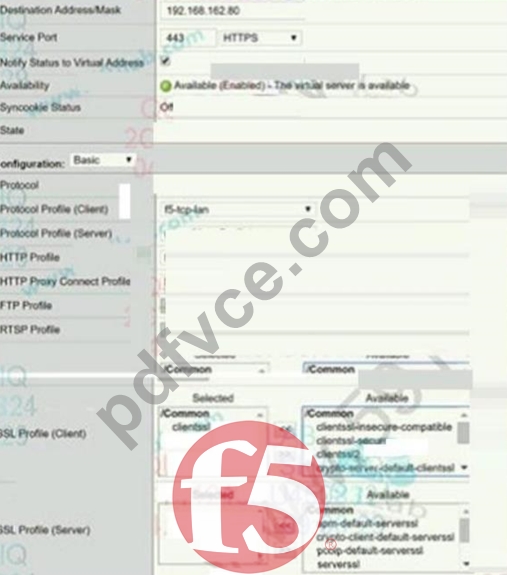
A BIG-IP Administrator needs to deploy an application on the BIG-IP system to perform SSL offload and re-encrypt the traffic to pool members. During testing, users are unable to connect to the application.
What must the BIG-IP Administrator do to resolve the issue? (Choose one answer)
- A. Configure an SSL Profile (Server)
- B. Configure Protocol Profile (Server) as splitsession-default-tcp
- C. Enable Forward Proxy in the SSL Profile (Client)
- D. Remove the configured SSL Profile (Client)
Answer: A
Explanation:
To successfully perform SSL offload and re-encryption on a BIG-IP system, the virtual server must be configured with both a Client SSL profile and a Server SSL profile. The Client SSL profile enables BIG-IP to decrypt inbound HTTPS traffic from clients, while the Server SSL profile is required to re-encrypt traffic before forwarding it to the pool members.
From the exhibit, the virtual server has a Client SSL profile configured, which allows BIG-IP to accept HTTPS connections from clients. However, there is no Server SSL profile attached, meaning BIG-IP attempts to send unencrypted HTTP traffic to pool members listening on HTTPS (port 443). This protocol mismatch causes the server-side SSL handshake to fail, resulting in users being unable to connect to the application.
This behavior is well documented in BIG-IP SSL troubleshooting guides: when backend servers expect HTTPS, a Server SSL profile is mandatory to establish a secure connection from BIG-IP to the pool members.
The other options are incorrect:
Removing the Client SSL profile (Option A) would break client-side HTTPS.
The server-side TCP profile (Option B) is unrelated to SSL encryption.
Forward Proxy (Option C) is only used for outbound SSL inspection scenarios.
Therefore, configuring an SSL Profile (Server) is the correct and required solution.
NEW QUESTION # 57
A BIG-IP Administrator disabled a virtual server with a pool that has a working health monitor. How does the status icon look for this virtual server?
- A. Black square
- B. Red square
- C. Red circle
- D. Black circle
Answer: D
Explanation:
BIG-IP status icons provide immediate visual feedback regarding the state of an object based on its availability and enabled/disabled status.
* Color (Black): The color black indicates that an object has been manually Disabled by an administrator.
* Shape (Circle): The circular shape indicates that the object is Available (i.e., its health monitors are passing).
* Scenario Result: Since the virtual server is manually disabled (Black) but its associated pool has a working health monitor that is currently passing (Circle), the resulting icon is a Black Circle.
NEW QUESTION # 58
Refer to the exhibit.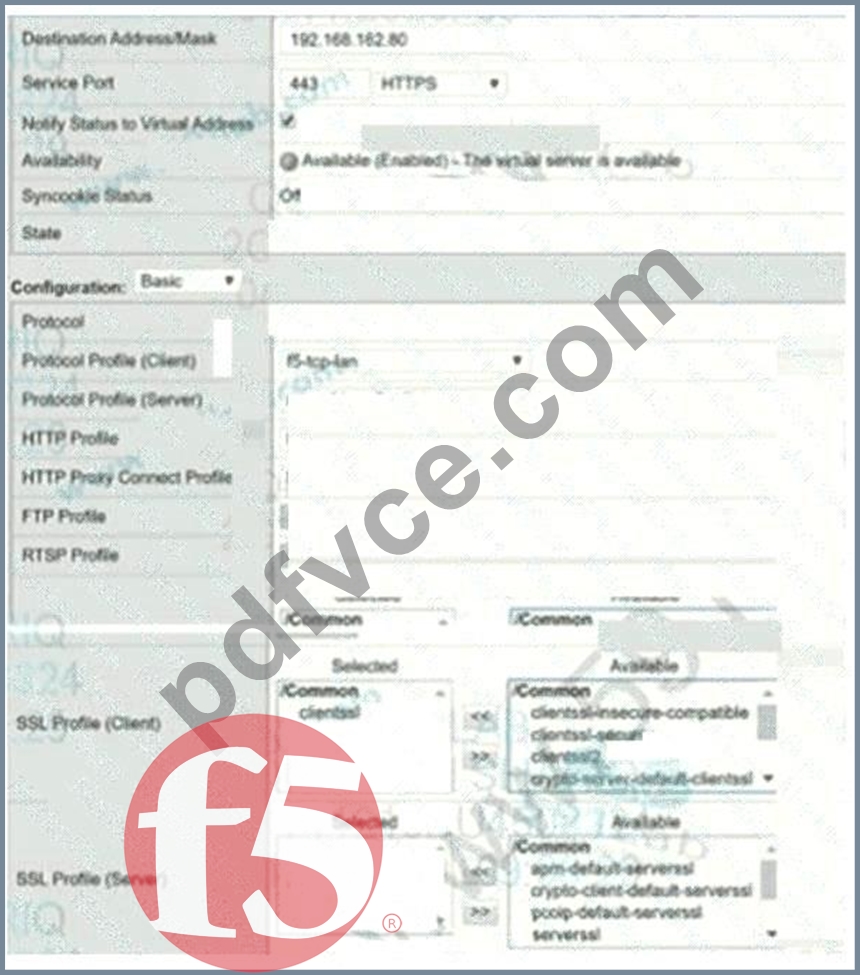
A BIG-IP Administrator needs to deploy an application on the BIG-IP system to performSSL offload and re- encrypt the traffic to pool members. During testing, users are unable to connect to the application.
What must the BIG-IP Administrator do to resolve the issue? (Choose one answer)
- A. Configure an SSL Profile (Server)
- B. Configure Protocol Profile (Server) as splitsession-default-tcp
- C. Enable Forward Proxy in the SSL Profile (Client)
- D. Remove the configured SSL Profile (Client)
Answer: A
Explanation:
To successfully performSSL offload and re-encryptionon a BIG-IP system, the virtual server must be configured withboth a Client SSL profile and a Server SSL profile. The Client SSL profile enables BIG-IP to decrypt inbound HTTPS traffic from clients, while the Server SSL profile is required tore-encrypt traffic before forwarding it to the pool members.
From the exhibit, the virtual server has aClient SSL profile configured, which allows BIG-IP to accept HTTPS connections from clients. However, there isno Server SSL profile attached, meaning BIG-IP attempts to sendunencrypted HTTP trafficto pool members listening on HTTPS (port 443). This protocol mismatch causes the server-side SSL handshake to fail, resulting in users being unable to connect to the application.
This behavior is well documented in BIG-IP SSL troubleshooting guides: when backend servers expect HTTPS, a Server SSL profile is mandatory to establish a secure connection from BIG-IP to the pool members.
The other options are incorrect:
* Removing the Client SSL profile (Option A) would break client-side HTTPS.
* The server-side TCP profile (Option B) is unrelated to SSL encryption.
* Forward Proxy (Option C) is only used for outbound SSL inspection scenarios.
Therefore, configuring anSSL Profile (Server)is the correct and required solution.
NEW QUESTION # 59
A BIG-IP Administrator needs to view the CPU utilization of a particular Virtual Server. Which section of the Configuration Utility should the administrator use for this purpose?
- A. Statistics > Module Statistics > Local Traffic > Virtual Servers
- B. Statistics > Module Statistics > Traffic Summary
- C. S70tatistics > Module Statistics > Local Traffic > Virtual Addresses
- D. Statistics > Analytics > Process CPU Utilization
Answer: A
Explanation:
Monitoring granular resource utilization is essential when troubleshooting performance degradation for specific applications. While global system stats show overall hardware health, they do not pinpoint which virtual server is overconsuming resources during traffic spikes. To identify the specific application causing a high CPU load, the administrator should navigate to Statistics > Module Statistics > Local Traffic > Virtual Servers. This section provides detailed metrics for each virtual server, including CPU cycles used for traffic processing and iRule execution. Identifying a "top- talker" or a problematic virtual server allows the administrator to take targeted action, such as optimizing an inefficient iRule, adjusting compression levels, or offloading the virtual server to a different device group. This targeted troubleshooting ensures that one high-demand virtual server does not negatively impact the performance of other services running on the same BIG-IP hardware, maintaining overall system stability and resource availability.
NEW QUESTION # 60
Clients report that they cannot reach the virtual server vs-production on port 80, but are able to ping the virtual server address. The configuration is shown below:
Plaintext
ltm virtual vs-production {
destination 10.99.20.50:http
ip-protocol tcp
mask 255.255.255.255
profiles {
http {}
tcp {}
}
source 192.168.0.0/16
translate-address enabled
translate-port enabled
vlans {
external
}
vlans-enabled
}
What is the cause?
- A. The virtual server is disabled.
- B. The client comes from an unallowed subnet.
- C. The client uses an old browser.
- D. The virtual server does NOT listen on port 80.
Answer: B
Explanation:
The issue is caused by the Source Address restriction configured on the virtual server.
* Source Filter: The configuration contains the line source 192.168.0.0/16. This acts as an implicit Access Control List (ACL). The virtual server will only accept and process TCP connections if the client's source IP address falls within the 192.168.x.x range.
* Why Ping Works: ICMP (Ping) is handled by the Virtual Address object, not the Virtual Server object. Unless ICMP is specifically disabled on the Virtual Address, it will respond to pings from any subnet, even if the Virtual Server itself is restricted by a source filter or is even disabled.
* Evaluation of Other Options:
* Disabled (Option A): If the VS were disabled, the configuration would typically show disabled or state down, and the symptoms would be similar, but the source filter is a more specific
"misconfiguration" in this context.
* Port 80 (Option C): The configuration destination 10.99.20.50:http explicitly confirms it is listening on port 80.
* Unallowed Subnet: If a client from a different network (e.g., 10.10.1.5) tries to connect, the BIG- IP will silently drop the connection or send a reset because it does not match the defined source criteria.
NEW QUESTION # 61
A BIG-IP Administrator adds new Pool Members into an existing, highly utilized pool. Soon after, there are reports that the application is failing to load for some users. What pool level setting should the BIG-IP Administrator check?
- A. Slow Ramp Time
- B. Allow SNAT
- C. Action On Service Down
- D. Availability Requirement
Answer: A
Explanation:
When troubleshooting a pool that is not working correctly after adding new members, the "Slow Ramp Time" setting is a primary suspect. In a pool that is already under high load and using a "Least Connections" load balancing method, a newly added server has zero connections. Without a slow ramp time, the BIG-IP will immediately direct a massive flood of new connections to the new server to "balance" it with the others. This "thundering herd" effect can crash a newly initialized application server before it has time to warm up its caches or establish its own database connections. By setting a "Slow Ramp Time" (typically in seconds), the administrator ensures the BIG-IP gradually increases the connection ratio to the new member. This allows the server to stabilize and scale up its performance over time. If users report intermittent failures specifically coinciding with the expansion of a pool, checking this setting is a vital troubleshooting step to maintain pool health during maintenance.
NEW QUESTION # 62
......
F5 F5CAB5 Exam Syllabus Topics:
| Topic | Details |
|---|---|
| Topic 1 |
|
| Topic 2 |
|
| Topic 3 |
|
| Topic 4 |
|
| Topic 5 |
|
Latest F5 F5CAB5 Dumps with Test Engine and PDF (New Questions): https://topexamcollection.pdfvce.com/F5/F5CAB5-exam-pdf-dumps.html